




Glass Tempering Furnace Equipment
The Glass tempering furnace equipment is a crucial industrial equipment used for glass processing. It is mainly applied in the tempering process of glass sheets or glass plates, which involves heating and quenching the glass to achieve the desired mechanical properties and optical characteristics. This equipment is essential for producing high-quality glass products that are used in various industries, including construction, automotive, and furniture. Our Glass tempering furnaces are designed to heat glass sheets or glass plates to temperatures ranging from 600°C to 70°C, depending on the type of glass being processed. The furnace is usually divided into three zones: a heating zone, a temperature holding zone, and a cooling zone. The heating zone is responsible for heating the glass to the desired temperature, while the temperature holding zone maintains the temperature of the glass sheets or glass plates constant. Finally, the cooling zone quenches the glass to achieve the desired mechanical properties. They can be either batch type or continuous type, depending on the type of production required. Batch type furnaces are suitable for small to medium-sized batches, while continuous type furnaces are suitable for high-volume production. Batch type furnaces usually have a smaller footprint and are easier to maintain, while continuous type furnaces offer higher productivity and less down time.
Series of our glass tempering furnace
H Series

|
Model |
Max Load |
Min.Glass |
Glass |
Production Rate |
Minimum |
Bow |
Local wave |
|
PG2436DT |
2440*3660 |
100*300 |
3.5-19 |
16-20 |
700 |
1% |
0.06 |
|
PG2450DT |
2440*5000 |
100*300 |
3.5-19 |
16-20 |
900 |
||
|
PG2460DT |
2440*6000 |
100*300 |
3.5-19 |
16-20 |
1000 |
||
|
PG2850DT |
2800*5000 |
100*350 |
4-19 |
16-20 |
1000 |
0.07 |
|
|
PG2860DT |
2800*6000 |
100*350 |
4-19 |
15-19 |
1200 |
||
|
PG3060DT |
3000*6000 |
300X450 |
4.5-19 |
15-19 |
1200 |
0.08 |
|
|
PG2436DTS |
2440*3660 |
100*300 |
3.5-19 |
24-30 |
1100 |
0.05 |
|
|
PG2450DTS |
2440*5000 |
100*300 |
3.5-19 |
24-30 |
1500 |
||
|
PG2460DTS |
2440*6000 |
100*300 |
3.5-19 |
24-30 |
1800 |
||
|
PG2850DTS |
2800*5000 |
100*350 |
4-19 |
24-30 |
1600 |
0.06 |
|
|
PG2860DTS |
2800*6000 |
100*350 |
4-19 |
23-29 |
1900 |
||
|
PG3060DTS |
3000*6000 |
300X450 |
4.5-19 |
23-29 |
2000 |
Product Advantages
● Domestically advanced forced convection heating technology can efficiently heat triple silver low-e of 0.01 emissivity.
● Intelligent remote monitoring and control system.
● Slave screen in the unloading end.
● Service page makes trouble shooting much easier.
● PID quenching air pressure control give 100%insurance that each and every panel is well tempered.
● Siemens PLC system enables reliability and precision in temperature control,and offers digital/O and Ethernet port.
● Intelligent power consumption Management System.
● Powerful back up battery drive system with long-life batteries.
JXSERIES

|
Model |
Max Load |
Min.Glass |
Glass Thickness |
Production Rate (5mm |
Minimum Peak |
|
PG2436DT |
2440*3660 |
100*300 |
3.5-19 |
16-20 |
700 |
|
PG2450DT |
2440*5000 |
100*300 |
3.5-19 |
16-20 |
900 |
|
PG2460DT |
2440*6000 |
100*300 |
3.5-19 |
16-20 |
1000 |
|
PG2850DT |
2800*5000 |
100*350 |
4-19 |
16-20 |
1000 |
|
PG2860DT |
2800*6000 |
100*350 |
4-19 |
15-19 |
1200 |
|
PG3060DT |
3000*6000 |
300X450 |
4.5-19 |
15-19 |
1200 |
|
PG2436DTS |
2440*3660 |
100*300 |
3.5-19 |
24-30 |
1100 |
|
PG2450DTS |
2440*5000 |
100*300 |
3.5-19 |
24-30 |
1500 |
|
PG2460DTS |
2440*6000 |
100*300 |
3.5-19 |
24-30 |
1800 |
|
PG2850DTS |
2800*5000 |
100*350 |
4-19 |
24-30 |
1600 |
|
PG2860DTS |
2800*6000 |
100*350 |
4-19 |
23-29 |
1900 |
|
PG3060DTS |
3000*6000 |
300X450 |
4.5-19 |
23-29 |
2000 |
Product Advantages
● Seamless Forced Convection Heating Technology@for bulk production of low-e tempered glass.
● To installation of FC fans, with high efficiency, extended service life while air cooling system makes maintenance much easier.
● More intensive heating zones of matrix control offers a more even heating.
● Innovative pass-through chiller considerably saves energy while dwarfing peak demand.
● Diffused and Zero-Overlapping Chiller nozzles offers full guarantee of uniform quenching thus to minimize anisotropy.
● Service page makes trouble shooting much easier.
● Siemens PLC system enables reliability and precision in temperature control.
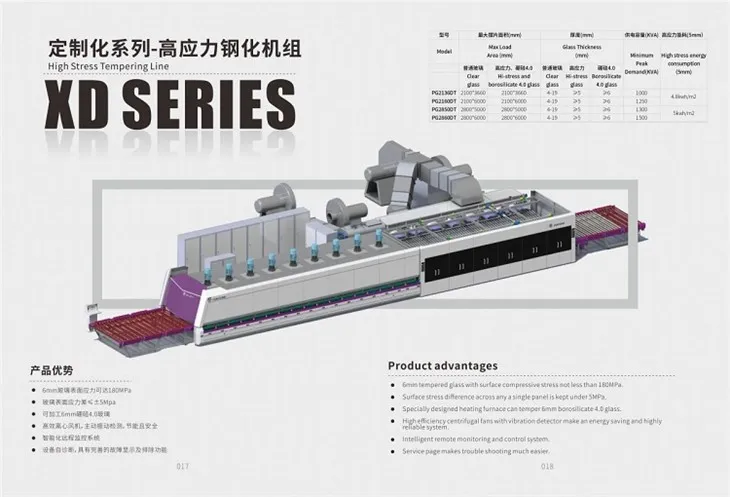
High Stress Tempering Line
XD SERIES

|
Model |
Max Load |
Glass Thickness |
Minimum |
|
|||
|
|
Clear |
Hi-stress and |
Clear |
Hi-stress |
Borosilicate.4.0 |
||
|
PG2136DT |
2100*3660 |
2100*3660 |
4-19 |
≥5 |
≥6 |
1000 |
4.8kwh/m2 |
|
PG2160DT |
2100*6000 |
2100*6000 |
4-19 |
≥5 |
≥6 |
1250 |
|
|
PG2850DT |
2800*5000 |
2800*5000 |
4-19 |
≥5 |
≥6 |
1300 |
5kwh/m2 |
|
PG2860DT |
2800*6000 |
2800*6000 |
4-19 |
≥5 |
≥6 |
1500 |
|
Product Advantages
● 6mm tempered glass with surface compressive stress not less than 180MPa.
● Surface stress difference across any a single panel is kept under5MPa.
● Specially designed heating furnace can temper 6mm borosilicate 4.0 glass.
● High efficiency centrifugal fans with vibration detector make an energy saving and highly reliable system.
● Intelligent remote monitoring and control system.
● Service page makes trouble shooting much easier.
Continuous Tempering Line
XD SERIES

|
Width(mm) |
Thickness |
Recommended |
Production(m 2/Day) |
Peak |
Recommended |
|
1300 |
2.5-4 |
42 |
30,000m²/Day(D)·3.2mm |
3800 |
Photovoltaic |
|
48 |
35,000m2/Day(D)·3.2mm |
4200 |
|||
|
60 |
44,000m2/Day(D)·3.2mm |
5000 |
|||
|
1400 |
2.5-4 |
42 |
32,000m²/Day(D)·3.2mm |
3900 |
|
|
48 |
37,000m2/Day(D)·3.2mm |
4300 |
|||
|
60 |
47,000m2/Day(D)·3.2mm |
5200 |
|||
|
1800 |
4-12 |
24 |
14.000m2/Day(D)·5mm |
2200 |
Architecture |
|
30 |
18,000m2/Day(D)·5mm |
2800 |
|||
|
36 |
22,000m2/Day(D)·5mm |
3400 |
|||
|
2100 |
4-12 |
24 |
16,000m2/Day(D)·5mm |
2600 |
|
|
30 |
21,000m2/Day(D)·5mm |
3100 |
|||
|
36 |
26,000m2/Day(D)·5mm |
3800 |
Product Advantages
● Seamless Forced Convection Heating Technology@for bulk production of low-e tempered glass.
● Special chiller design enables bulk production of heat strengthened glass.
● Intelligent remote monitoring and control system.
● Slave screen in the unloading end.
● Service page makes trouble shooting much easier.
● Siemens PLC system enables reliability and precision in temperature control,and offers digital/O and Ethernet port.
● Intelligent power consumption Management System.
● IR scanner system.(Optional)
● Backup DC drives working on powerful UPS.
Bending and Tempering System
XD SERIES

Lengthwise Bender Chiller Technical Requirements
|
Arc |
Adaptive glass |
Min R |
Thickness |
|
500 |
≤2400 |
300 |
5~12 |
|
800 |
≤2400 |
420 |
5~12 |
|
1000 |
≤2400 |
500 |
5~12 |
|
1200 |
≤2800 |
600 |
5~12 |
|
1500 |
≤2800 |
700 |
5~12 |
|
1800 |
≤2800 |
800 |
5~12 |
Cross Bender Chiller Technical Requirements
|
Arc |
Adaptive glass |
Min R |
Thickness |
|
500 |
≤2400 |
300 |
5~12 |
|
800 |
≤2400 |
420 |
5~12 |
|
1000 |
≤2400 |
500 |
5~12 |
|
1200 |
≤2800 |
600 |
5~12 |
|
1500 |
≤2800 |
700 |
5~12 |
|
1800 |
≤2800 |
800 |
5~12 |
|
2000 |
53000 |
900 |
5~12 |
|
2200 |
≤3000 |
1000 |
5~12 |
|
2500 |
≤3000 |
1100 |
5~19 |
|
3000 |
≤3300 |
1250 |
5~19 |
|
5000 |
≤3300 |
2500 |
6~19 |
Product Advantages
● The mechanism delicately combines mechanical gemels with value correction and compensation to enable quick and accurate forming. Each and every joint moves in a controlled manner. Simple and reliable structure improves reliability.
● The counting encoder monitors the arc forming and adjustment, which can easily observe and adjust the size of the bending radius, making the operation convenient and fast.
● Discrete and non stacked air hole layout can effectively reduce the wave.022
Features of Glass Tempering Furnace Equipment
We have variety of features standard in our machines as well as optional features which you can choose and configure and enhance your machine.
Automatic Cooling Nozzle Positioning
Cooling unit top nozzle is positioned automatically depending on glass thickness. In order to prevent glass breaks and surface fluctuations, the Screw Jack (Trapezoidal Spindle) is positioned precisely and reduced due to positioning errors compared to chain systems.
Regional Temperature Control
Thanks to heat control system infrastructure homogeneous heating is automatically distributed for entire heat zones. With CMS software technologies and infrastructures, heating temperature of the zones are controlled instantly depending on glass type and its recipe.
Automatic Glass Bending Unit
Automatic glass bending unit (Opt. Y) optionally can be integrated to this model of glass tempering furnace. It is designed to make tempered bend glass at desired radius. The glass bending unit is controlled by a servo motor and can precisely bend the glasses with ease.
Recipe Management
In this machine we offer advanced recipe management system which can save your custom settings like different glass types, different glass thickness and many more information for later usage which makes the usage of the machine more easy for any operator who use the machine.
Operator Panel
We offer advanced but very easy to use control panel system which improves the operability of the machine, but also offer an outstanding design and advanced technology. This innovative control panel system we have developed comes with remote control access system for aftersales purposes.
Remote Access System
Remote technical assistance system based on a set of software tools that allows authorized staff of our after sales services to manage maintenance or assistance tasks anywhere in the world quickly and efficiently. Access via the Internet is always done with the prior consent of the customer.
The Process of Glass Furnace Tempering Equipment
Preparation: The first step in glass furnace tempering is the selection of suitable glass. Typically, it involves using a high-quality, low-iron glass that is free of impurities. The glass is cut and shaped to the desired dimensions. The furnace at Techni-Glass accepts glass up to 82" x 156" in size and 3.2 mm – 19 mm in thickness.
Heating: The glass is placed into a tempering furnace, where it is heated to a temperature of around 620 to 680 degrees Celsius (1150 to 1250 degrees Fahrenheit). This temperature is just below the glass's softening point.
Quenching: After reaching the desired temperature, the glass is rapidly cooled using high-pressure air jets. This quick cooling process induces surface compression while allowing the interior to remain in a state of tension.
Final Inspection: The tempered glass is thoroughly inspected for any defects, ensuring its quality and safety.
Reminders When You Buy Glass Tempering Furnace
Locate the Market and Select Features
First of all, you should start from considering your tempered glass market and position the tempering furnace function. At present, the main tempering furnaces in the market are: flat tempering furnace, bending tempering furnace, flat tempering furnace with bending section, bending bidirectional tempering furnace, continuous tempering furnace, and unequal arc tempering furnace. Different types of tempering furnaces have different uses, and you can choose the tempering furnace function according to your needs. If you need to process Low-E glass, be sure to choose a convection tempering furnace, because the forced convection system tempering furnace is suitable for processing tempered Low-E glass and coated glass that with different heat absorption rates on up and down sides, so that it can meet the tempering process of high-quality building and furniture flat glass, etc. The types of tempered glass are: online Low-E glass, offline Low-E (E=0.02) glass, ultra-clear glass, screen printing glass, patterned glass, colored glass, clear glass, etc. Of course, if you want a wider product coverage, you can consider a flat-bending two-way tempering furnace, which can be used for both flat glass and curved glass. Of course, the cost of this kind of tempering furnace will be relatively high.
Glass Processing Thickness
Different glass thicknesses will determine the type of blower used in the tempering furnace, resulting in a great difference in the price of the tempering furnace. When you choose a tempering furnace, you must carefully decide whether to start at 4mm or 5mm. Glass for construction engineering generally requires a thickness of 5mm to start. If there is Low-e glass, a convection glass tempering furnace with a larger width and a higher loading rate should be selected;
For interior decoration, the sliding door glass generally requires a thickness of 4mm to start, and there is no Low-e requirement. You can choose a radiant glass tempering furnace with a moderate width and a good loading rate;
Glass for household appliances is generally made of thin glass, small in size and high in quality. Small-sized single-chamber, double-chamber or continuous glass tempering furnaces can be selected according to output requirements;
Solar photovoltaic glass generally uses thin glass with a thickness of 2.8mm-3.2mm, with a fixed size and large output, which is suitable for continuous glass tempering furnaces;
Automobiles, instruments, etc. belong to special glass, and special tempering furnaces are required.
Site Area
Different furnace types, such as flat tempering furnace, bending tempering furnace, flat and bending tempering furnace, double-chamber furnace, continuous furnace, etc., have great differences in longitudinal length. Customers should select the type according to the actual reserved area. In addition, Not only the placement of equipment, but also the space required for production, the placement of glass before loading and finished products after unloading, etc.
Power Load
The installed power of different furnace types is different. Taking 4mm white glass tempering as an example, the installed power of 2000x3000mm radiation furnace is about 400KVA, and the installed power of 2440×3660 convection furnace is about 630KVA. Enterprises should consider the installed capacity and expansion of transformers accordingly.
Glass Tempering Furnace Operation Importance
The operation of the glass tempering furnace should be intelligent, simple and easy to operate, reduce the dependence on people, improve the quality and yield, and reduce the production cost.
Glass Tempering Furnace Stability
The glass tempering furnace must operate stably and ensure that the equipment operates smoothly under normal conditions, so as to fully guarantee the customer's production requirements; if the equipment fails frequently during operation, it will not only increase the loss rate of the float glass, but also reduce the production efficiency, increase production costs, and even cause delays or changes in product delivery time, damage reputation, and seriously damage the interests of producers.
About us
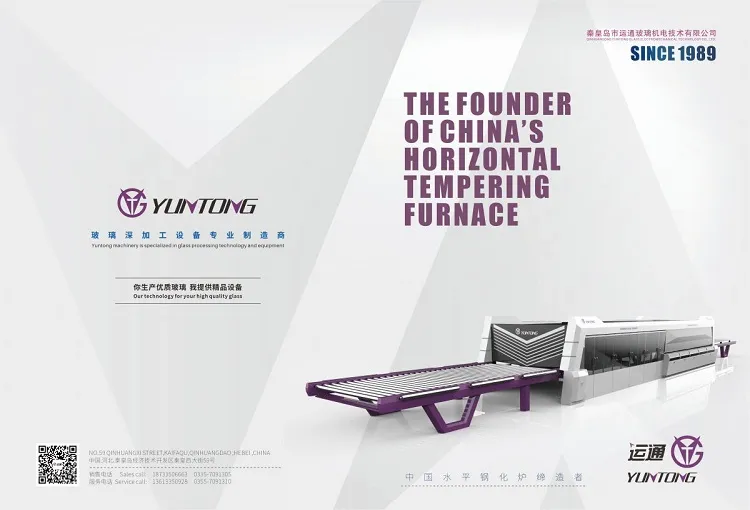
Yuntong Glass is a high tech company located in Qinhuangdao Industrial Park, specializing in research, design and manufacturing glass production and processing machines. Started in 1989, it has been the 1st company making flat tempering furnace in China. Now Yuntong offers a wide choice of tempering furnaces for flat tempering furnace and exported various machines to over 60 countries around the world.

If you are looking for glass tempering furnace equipment manufacturer, Yuntong is an ideal choice! Contact us today.
Hot Tags: glass tempering furnace equipment, China glass tempering furnace equipment manufacturers, suppliers, factory, Flexible Metal Corner Tape, Sintered Stone Worktops, Flange For Oil Gas Pipeline, Steel Ocean Light Buoy, Fire Sprinkler Flexible Drop Hose, Fibreglass Car Body Shell
Send Inquiry
